Showing posts with label reading. Show all posts

Sunday, March 31, 2013

Reflecting on #TheWonderOfWonder

 Just before Easter break my students and I finished our third read aloud of the school year: Wonder by RJ Palacio. Each book we have read together as a class has had an impact on them, but I think Wonder has had the biggest impact.

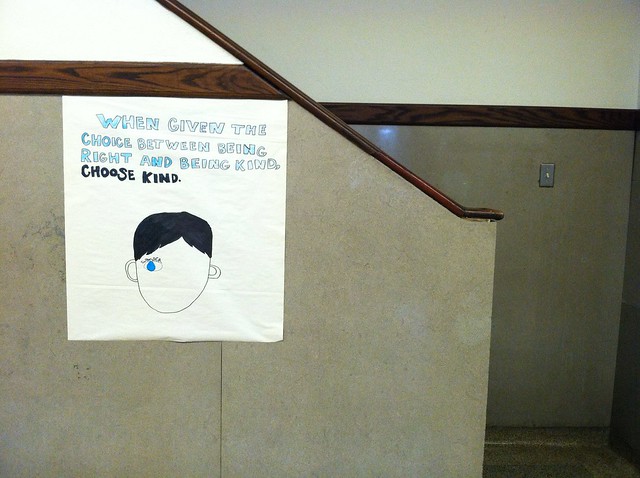
After we finished the book, I made this poster to hang outside my classroom:

But then some of my students made this poster as well to hang outside the library:


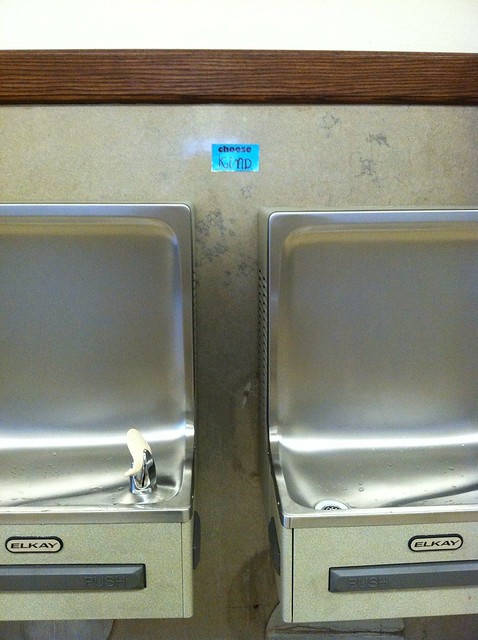
But I have also made sure that Choose Kind is not just something that is shouted at students in the form of a giant poster. I also have left subtle reminders around the junior high hallway and in my classroom:
At the drinking fountain...

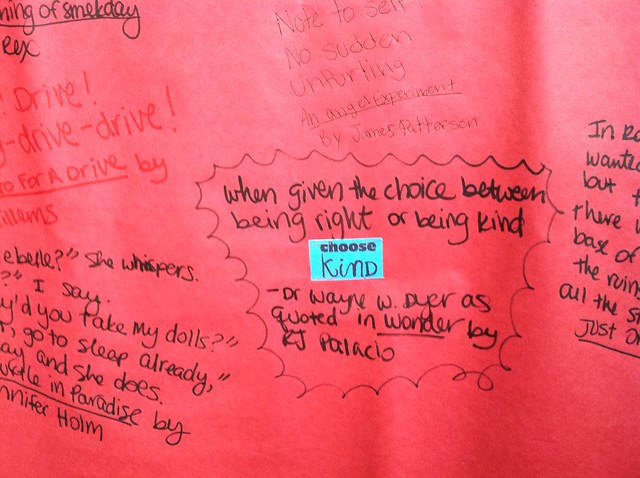
...On our book quote wall

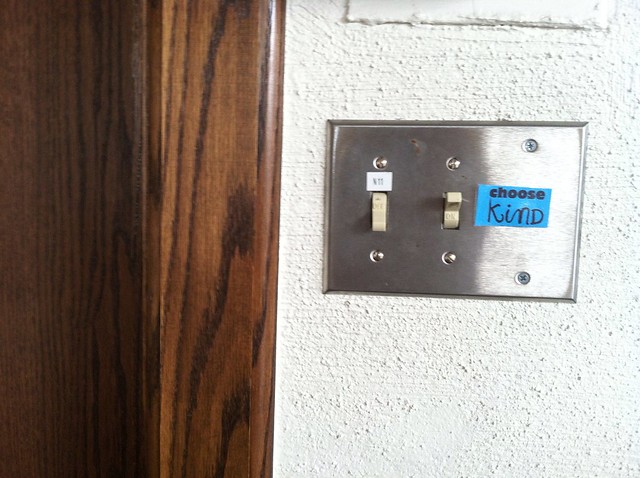
...even our classroom light switch reminds students of the importance of being kind

Another way I've noticed the impact Wonder has had on my students is their amazing reflections they've written about, particularly the question I wrote as follows:

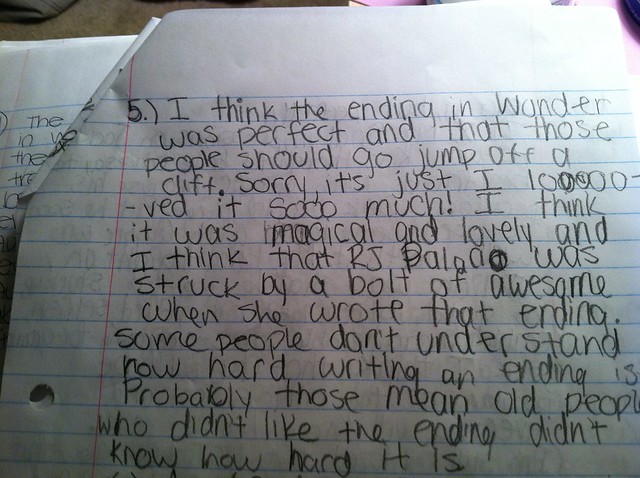
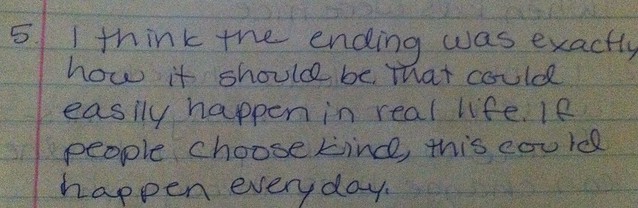
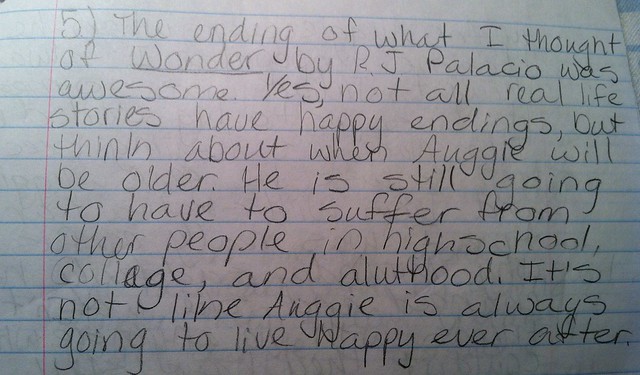
Many people who criticize Wonder say the ending is too perfect and that real life stories just don't end that happily. What do you think of how the story ended?

Naturally there were a few students who agreed with the critics, but on the whole, I received responses mostly like these:


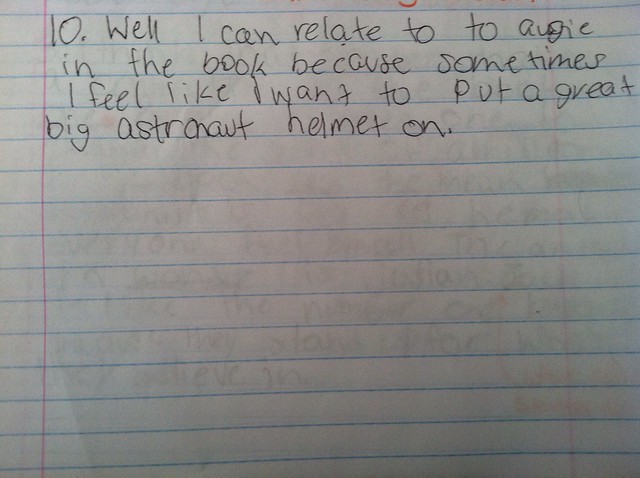
 And then there is my favorite response to the question, how do you personally relate to the characters and situations in Wonder?


So my only question to you is: if you haven't read this book yet, what are you waiting for?


Saturday, February 2, 2013

Continuing to reap the benefits of kids knowing their reading rate

I am not known for my prowess with numbers. That is why I became an English teacher. If I had to teach math I wouldn't probably cry, I would definitely cry. So when people start talking numbers and data, especially when it comes to things like test scores, my eyes glaze over. I think there is a chunk missing out of my left brain or something because when you start asking me to think of my students in numerical terms, I cannot process it. (Perhaps it's a bit of the obstinacy in me too)

So it's ironic that one of the most important activities I have done in my classroom in the past month since returning from Christmas break involves math.

I mentioned in a previous post that I participated in the Book Love book club over Christmas break, and one of the things I realized from being a part of that book discussion is the need for students to have some sort of idea of how much stamina they actually have for reading. Thus the reading rate activity was born. When I talked to each one of my students individually after completing the reading
Example of a student figuring out her reading rate
rate exercise, I was amazed at how empowering it was for them to know how much (or little) stamina they had for reading. Students who had a lot of stamina were surprised and delighted, saying things like, "I didn't realize I could read that much," or, "I can't believe I can read almost a whole book in two hours!" Students who had little stamina often said something along the lines of, "I'm disappointed with this number but I want to work to make it higher."

I was not expecting this to be such a motivating tool for students, but lo and behold, it was.

But in addition to being motivating, it has the added benefit of helping students realize what they are capable of despite what they think to be true. On Friday I assigned literature circle books to all of my 6th graders. They spent the entire first half of the year choosing their own books and exploring their reading preferences so now it was time for them to put their new stamina to work and see how they do with a book that someone assigns to them.

The first thing I had them do on Friday was to read their newly assigned book for ten minutes to see what their new reading rate was. Once they knew their reading rate for that book, I had them meet with their groups to decide what pages they should be finished with for each of their three discussion meetings. As I was walking around the room, observing and listening to students working together to decide on page numbers, I noticed one particular group was getting a bit heated about what page they should read to for their first meeting. One student in particular thought reading 70 pages in one week was too much, and when I asked her what her reading rate was, she told me 108 pages. When I pointed out to her that if she can read 108 pages in 2 hours, then she can read 70 pages in a week, there was no more argument. The group settled on 70 pages and that was the end of that.

So I guess if I have to do any sort of math in my classroom, I'm glad it's the kind of math that helps my students see what is possible in their own reading lives, especially when they don't realize just how much they are truly capable of.

Wednesday, January 9, 2013

We should be listening to our students, not reading test scores

The return to school from Christmas break has been rough. In more ways than one. But today there was some light in an otherwise dismal week.

Over break I participated in a book discussion on Facebook and Twitter for Penny Kittle's newest book called Book Love. I had read the book in November and loved it, declaring it worthy of the same pedestal on which I hold The Book Whisperer. It was through the book discussion I realized that upon the first week back from break, I would make sure that students would be figuring out their reading rate.

In Penny's class she has students figure out how many pages they can read in two hours so they know how much weekly independent reading is expected of them. Reading rate is calculated by:


  • having students choose a book they consider at just the right level for them
  • Timing their reading for ten minutes
  • Calculating the number of pages read in those ten minutes
  • Multiplying that number by six to figure out their hourly rate
  • Then multiplying that number by two to figure out how many pages they should be reading weekly on their own.

Having students complete this exercise yesterday was eye opening. I had students reading anywhere from 4 pages to 28 pages in ten minutes! How can you hold both of those students to the same reading standard? You can't.

But the eye opening part really came today when I started conferring with them about their numbers.
A lot of students talked about how they interpreted their numbers and many of them said that their numbers depended on what kind of book they were reading. I heard a lot of discussions that began much like this: "Well, I was reading a really good book so of course my numbers were higher. If I was reading a boring book this number would be much lower." This was not from my prompting whatsoever. I just asked them what they thought of their numbers.

The other conversation I had with a student is one I've had many times: the absolute necessity for teachers to have extensive classroom libraries. When I was talking to a student today about her reading rate, she explained to me that she was really happy with her numbers and she knows that they would have been lower last year because last year she didn't like reading and now she does. When I asked her what made the difference she said, "This year I have way more books to choose from than I did in years past. Plus, doing so much reading made me realize what genres I like best."

Talking to these students and hearing from their own mouths what they think of their numbers made me realize even more what a travesty it is that our educational system relies so heavily on test scores. Here I have a group of students who calculated some data and were able to interpret what those numbers mean for THEMSELVES. They knew that those numbers are not static and can fluctuate from day to day and book to book. But politicians and educational reformers look at numbers and only see black and white, success or failure. If I learned one thing today it is that we need to be listening to what our students are telling us about their numbers, not asking the numbers to tell us about our students.